
Scrapebox is undoubtedly the most popular SEO tools, also known as the swiss knife of Digital Marteters and SEO Agencies. One of biggest question we are being asked as a web hosting company is what is the ideal plan to run Scrapebox.
While it is possible to run Scrapebox on your own computer (and since very recently it is also possible to run Scrapebox on a Mac OS based computer), it is of common knowledge that a Windows VPS is far more suitable.
Why Windows VPS for Scrapebox (Not Linux)
Scrapebox is a Windows-native application. Running it through RDP or Wine on Linux introduces latency and compatibility hiccups. A dedicated Windows VPS gives you direct OS-level control, proper RDP access, and the ability to manage Scrapebox settings without workarounds.
Linux VPS is cheaper , correct yet the Wine’s emulation resources tax and the non native parts makes Windows the must go choice.
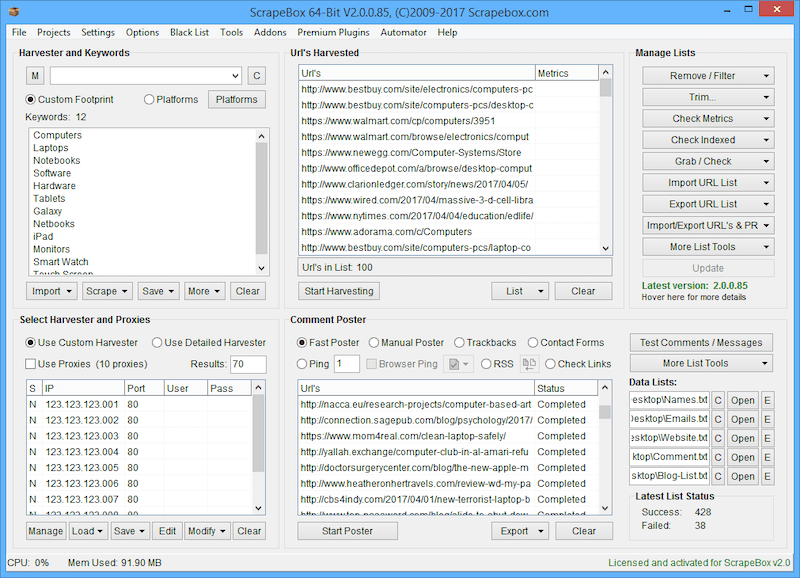
Minimum Specs: What Scrapebox Actually Needs
Need to Run Scrapebox?
Launch an Ultra Reactive Remote Desktop from any of our 19+ Locations 🚀 SEO Tools Ready
Scrapebox itself is lightweight. The app uses under 200MB RAM at idle. The problem is concurrent threads.
- RAM: 1GB minimum for. Jump to 8GB if you run 500+ threads or stack Scrapebox with other tools.
- CPU: 2 cores handles light scraping. 4 cores recommended if you’re running keyword research + scraping simultaneously.
- Storage: 50GB SSD. Scrapebox databases and scraped data add up fast.
- Bandwidth: Unmetered or 10TB/month minimum. Scrapebox pulls a lot of HTTP requests; you’ll hit 2–5TB/month on active campaigns.
HostStage Windows VPS: Purpose-Built for Your Workflow
HostStage’s KITTEN Windows VPS ($15.95/mo) gives you 2 cores, 2GB RAM, and 30GB NVMe SSD—solid starting point for light Scrapebox use. Scale to PANTHER (4 cores, 8GB RAM, 60GB NVMe) at $44.95/mo when you need the headroom for 300+ threads.
Our datacenters don’t throttle HTTP requests. Your scraping runs at full speed, and you manage IP reputation directly—no surprise blocks from careless hosting neighbors.
Configuring Scrapebox on Windows VPS: Quick Setup
1. Install Scrapebox
Download and extract Scrapebox on your VPS. No license keys needed for the core app; features like Pinger and API modules require separate payment.
2. Tune Thread Count
Start with 50 threads. Monitor VPS CPU and memory usage. For 8GB RAM, 150–200 threads is safe; for 12GB, push to 400. Stop when you see RAM saturation or CPU throttling.
3. Proxy or Native IP?
If you’re scraping Google SERPs, use your VPS’s native IP for the first pass (test blocking). If you hit blocks, rotate through proxies. For URL harvesting (blog comments, forum lists), native IP is fine if you vary user-agents and add delays.
4. Monitor Logs
Scrapebox logs scraping results in-app. Check monthly for “blocked” entries. If 20%+ of requests fail, it’s time to pause and let the IP cool or rotate to a proxy.
Common Mistakes (Avoid Them)
- Running Scrapebox On your computer: Long haul tasks crash, bandwidth throttling, impossible to share access all are reasons why you just shouldn’t.
- Linux VPS with Wine: Causes random crashes and slow response times. Skip it.
- Undersized RAM: Scrapebox will lock threads under memory pressure. You’ll think the tool broke; it’s just choking.
- No user-agent rotation: Targets detect and block faster. Use Scrapebox’s UA plugin or rotate manually.
- Neglecting rDNS: A proper reverse DNS lookup reduces blocks by ~40%. Ask your host to set it up.
- Ignoring datacenter blocks: If your VPS datacenter is blacklisted, no amount of tuning helps. Switch hosts if blocks persist.
FAQ
Can you run Scrapebox on shared hosting?
No. Shared hosting blocks command-line access and RDP. You need a VPS or dedicated server. VPS is the cost-effective sweet spot.
Does Scrapebox work on Mac or Linux?
Scrapebox is Windows-only. You can run it via VM or RDP into a Windows VPS, but that’s slower and adds complexity. Use a Windows VPS instead and access it from any OS (MAC, Linux or Windows)
How much bandwidth does Scrapebox use monthly?
Light use (50 threads, blog-scraping): 500GB/month. Medium use (200 threads, mixed scraping): 2–3TB/month. Heavy use (500+ threads, SERPs + harvesting): 5–10TB/month. Unmetered bandwidth is safer.
Is it legal to scrape with Scrapebox?
Check the target site’s robots.txt and terms. Public URLs and aggregate data are generally OK; personal data and copyright content are not. Follow site rules and add delays to reduce server load.
What’s the difference between Scrapebox and GSA Search Engine Ranker?
Scrapebox harvests URLs and data (blogs, directories, forum comments). GSA builds backlinks using those URLs. They’re complementary—Scrapebox finds the targets, GSA submits links.