
AI crawler bandwidth is an operating cost worth measuring. A bot can consume data transfer and application capacity without sending valuable visitors back. But blocking every automated request can also remove discovery you wanted to preserve. The useful decision is specific: which crawler may access which routes, at what cost, and for what business purpose?
This guide explains how to distinguish crawler identity from its claimed name, calculate incremental costs, and choose between allowing, throttling, blocking, or selling controlled access. Start with your logs and invoices; crawler volume alone proves neither harm nor commercial demand.
Separate Crawler Purpose from Identity
Search indexing, model training, user-requested retrieval, and commercial data collection are different uses. Do not give them one blanket permission merely because they all look like bots.
For example, OpenAI documents separate controls for OAI-SearchBot, which supports ChatGPT search, and GPTBot, whose crawled content may be used for model training. ChatGPT-User handles certain user-initiated visits and is not an automatic web crawler; OpenAI says robots.txt rules may not apply to those requests. These distinctions are specific to the operator, so check the current documentation for every bot you assess.
A recognizable User-Agent is only a claim. Compare it with the operator’s documented verification method, such as published IP ranges, where available. Keep those references current. If using a provider’s reverse-DNS method, also perform its required forward lookup; a familiar-looking hostname is not sufficient. Never grant account access or bypass all security checks solely because a request names a trusted bot.
Record the claimed operator, intended use, verification result, allowed routes, and observed behavior. Keep unidentified requests in a separate group. You can still control costly traffic whose operator is unknown, but label its attribution as uncertain rather than reporting it as a named company’s confirmed consumption.
Measure Requests, Bytes, and Origin Work
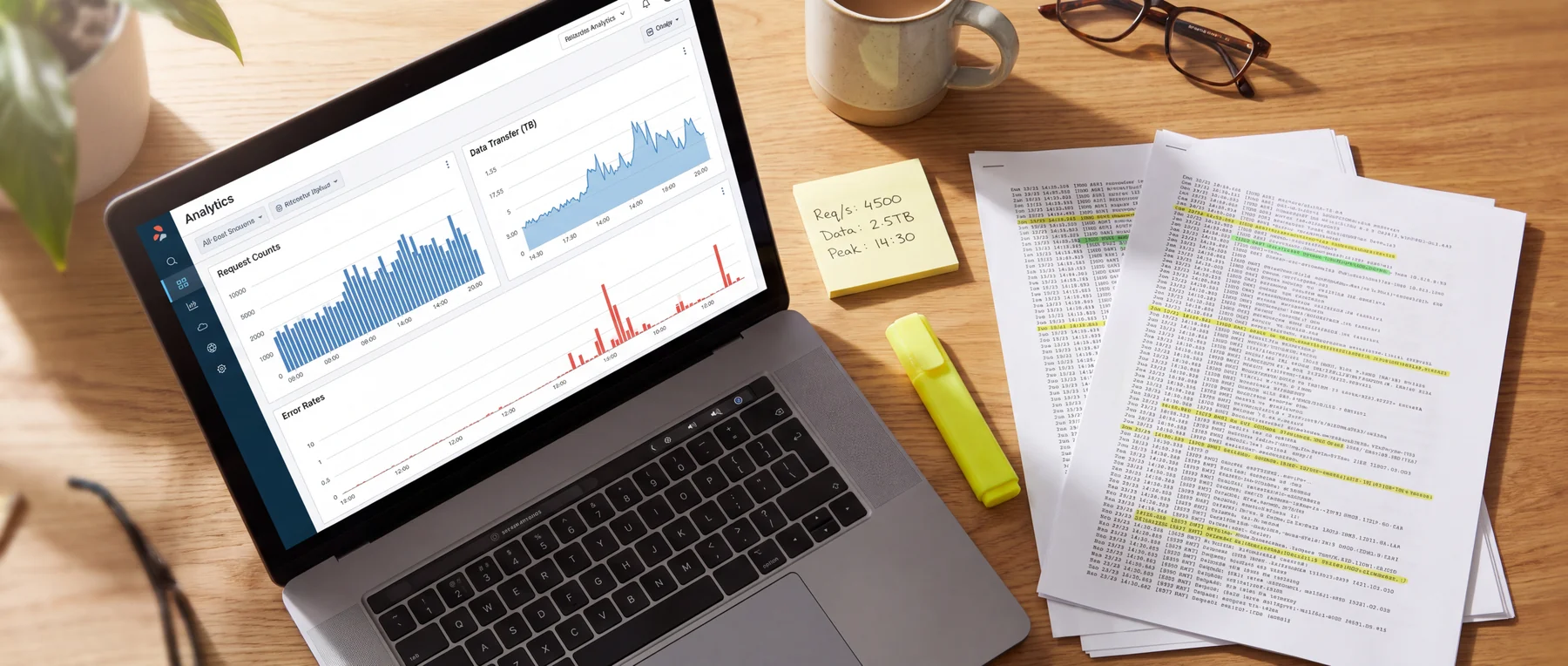
Use CDN or hosting analytics, web-server logs, application monitoring, and billing exports together. Browser analytics alone can miss automated requests that never run the site’s tracking code. Conversely, origin logs omit requests served entirely from an upstream cache. Identify which part of the delivery path each dataset covers before combining it.
| Measure | Where to look | What it tells you |
|---|---|---|
| Requests and status | Edge and access logs | Request rate, targeted routes, and failures. |
| Response bytes | Delivery logs and usage reports | Large downloads and total delivered data. |
| Cache outcome | CDN and reverse-proxy logs | Which requests still reach the origin. |
| Application work | Upstream timing and resource monitoring | Slow routes and possible CPU, worker, or database contention. |
| Billable usage | Provider invoice and usage export | Which consumption actually changes the bill. |
Define each field precisely. NGINX’s body_bytes_sent variable excludes response headers. Its request_time variable measures elapsed request processing time, including delivery to the client; it is not a direct CPU-time measurement. Neither field alone reproduces a provider’s billing meter.
Group records by verified or suspected bot, route, response type, cache outcome, and a consistent time interval. Use the same timezone across datasets. Rank both transferred bytes and origin requests: a crawler downloading large cached PDFs can lead the first ranking, while repeated dynamic searches dominate the second.
Compare crawler bursts with human-facing latency, application errors, and resource queues. Check deployments, backups, marketing traffic, and other concurrent activity before assigning causation. A useful test is a narrow, reversible policy change followed by comparison over similar traffic periods. Preserve the pre-change baseline and record exactly what changed.
Keep sensitive query parameters and credentials out of analysis exports. Limit log access and retention to what the investigation needs. You need enough evidence to attribute load, not an uncontrolled copy of customer data.
Calculate Incremental Cost and Observable Value
Ask what expense would disappear, or what constrained capacity would become available, if the crawler’s traffic stopped. Included transfer may have no additional charge while origin work still consumes scarce capacity. A fixed server bill does not automatically fall in proportion to the percentage of bot requests.
| Worksheet item | Use this evidence |
|---|---|
| Additional transfer charges | Measured billable bytes, allowance, region, tier, and invoice terms. |
| Request and compute charges | Attributable metered requests and compute usage. |
| Edge and protection costs | Relevant CDN, WAF, or function charges without double counting. |
| Avoidable capacity expense | An upgrade or resource allocation demonstrably required by that load. |
| Operational time | Recorded investigation, rule maintenance, and support effort. |
| Observable return | Attributable referrals, qualified leads, contribution margin, or paid-access income. |
Separate the cash total from capacity pressure and uncertain business effects. Estimate lost sales only when you have a defensible method and label the uncertainty. Do not add the whole hosting bill, a hypothetical upgrade, and an allocated share of that same capacity as three separate costs.
Calculate delivered data from measured bytes rather than request count alone. A request-based cache-hit percentage also does not tell you the fraction of bytes avoided: large responses may have a different hit rate from small ones. Reconcile edge delivery, origin delivery, and billable usage separately, using the provider’s GB or GiB convention.
On the value side, distinguish citations, referral visits, qualified leads, and revenue. They are different outcomes, and one does not guarantee the next. A first-party analytics setup can help connect identifiable referrals to later actions, but missing referrers and attribution gaps remain. Do not add last-click and assisted-conversion revenue if they represent the same sale.
Use comparable periods and avoid dividing a new sale by an unrelated batch of crawl requests. Model-training access may have no directly observable return. If you keep it open for a strategic reason, write down that reason and its review date instead of inventing a dollar value.
The decision is then practical: does the defensible return justify the incremental expense and operational burden? If the answer is uncertain, retain a bounded experiment or restrict expensive routes. No universal request count or revenue threshold can decide this for every site.
Choose the Control That Prevents the Cost
Apply the control before the resource you want to protect is consumed. An application rejecting a request after expensive database work does not recover that work. An edge rule may protect the origin while leaving some edge processing and delivery charges in place.
| Control | Useful effect | Limit to remember |
|---|---|---|
| robots.txt | Communicates crawling preferences. | Depends on crawler compliance; provides no authentication. |
| Edge rejection | Stops matching requests before the origin. | Can affect legitimate traffic; edge costs may remain. |
| Rate and concurrency limits | Bounds bursts and simultaneous work. | Allowed requests still consume resources. |
| Public-content caching | Avoids repeated origin generation. | Cache misses and delivered bytes still matter. |
| Route restrictions | Protects expensive or unwanted URL spaces. | Rules must preserve intended human and search access. |
| Authenticated access | Associates approved usage with an account and quota. | Requires credential, billing, and abuse management. |
Separate signals from enforcement
Google’s robots.txt guidance explains that compliance is voluntary and that a disallowed URL can still appear in search if discovered elsewhere. Protect private content with actual access controls. Likewise, the llms.txt proposal concerns information for agents; publishing a file does not authenticate a buyer or enforce a transfer limit.
Avoid broad rules until you understand their matches. A blanket bot block, wildcard robots rule, or shared IP restriction may affect conventional search and legitimate integrations. Keep authentication and payment callbacks working, and check the crawlers you intended to preserve after each change.
Protect expensive routes and cache safely
Budget dynamic search, filtered URLs, large downloads, and APIs separately from ordinary public pages. Request rate, concurrent work, and response size are different constraints. A distributed crawler can also cross a per-IP limit using many addresses; use verified identity or account-based controls where supported.
Check the actual cache configuration. Cloudflare’s default cache behavior, for example, does not cache HTML or JSON by default. Explicit rules may be needed for safe public responses. Exclude personalized, authenticated, checkout, and administrative content, and test that cached responses cannot cross user boundaries.
Optimize large public assets and text compression before buying more capacity. Test new filtering in logging or monitor mode when available, review false positives, then enforce narrowly with a rollback plan. A rule is useful only if it reduces the intended cost without disrupting the visitors and services you chose to support.
Test Whether Paid Access Has Buyers

Frequent crawling demonstrates consumption, not willingness to pay. Before building a commercial service, identify a buyer, the exact content they need, their update frequency, and the access terms they will accept. Your operating model should follow that demand.
- Paid API: appropriate when buyers need selected records or queries and you can support authentication, quotas, versioning, and availability.
- Structured feed: useful for recurring updates where a defined export avoids repeatedly fetching presentation pages.
- Versioned dataset: suitable when a buyer can work from a snapshot and does not need continuous access.
- Authenticated crawl: useful when the HTML structure itself matters, with route scope and usage limits agreed in advance.
Compare expected income with implementation, delivery, billing, support, and maintenance costs. Keep forecasts separate from signed commitments. Document permitted uses and confirm that you can license the material before offering it. A public page or a payment response by itself does not establish a commercial agreement.
As checked on 29 September 2026, Cloudflare describes Pay Per Crawl as a closed beta. Its documented mechanism lets participating crawlers present payment intent or receive an HTTP 402 response with pricing. Existing WAF or Bot Management blocks can take precedence. Treat this as an option to evaluate for eligibility and participating demand, not a payment switch that every crawler must use.
Cloudflare’s FAQ also distinguishes successful chargeable responses from errors and lists always-free paths. Review the live product terms and account setup before estimating income. For any paid-access method, give the customer clear usage records, a revocation process, and a defined support route.
Scale and Review Only the Demand You Choose to Keep
Upgrade when useful demand still creates a measured bottleneck after sensible caching and access controls. Extra capacity alone does not solve a policy problem. Compare CPU, memory, application workers, storage I/O, transfer terms, and the controls your team can actually operate.
For a managed environment, review HostStage’s managed VPS with cPanel and discuss your measured traffic pattern, log access, cache requirements, and filtering needs before choosing a plan. Confirm the current price, transfer allowance, management scope, and any third-party service costs. A hosting plan is not a guarantee of bot monetization or a substitute for application-specific testing.
Our managed VPS guide provides additional hosting context. If migration is justified, preserve the crawler rules, monitoring, and rollback procedure; compare the new system with the same baseline after the change.
Keep a short decision record for each significant crawler: identity confidence, routes, cost evidence, observed return, chosen action, owner, and review date. Revisit it after a traffic spike, a provider billing change, a new crawler policy, or a material change in referrals. Check routine policies periodically rather than leaving unexplained rules in place indefinitely.
Finish with one explicit outcome: allow bounded access, throttle while gathering evidence, block unwanted demand, or negotiate paid access. Record what evidence would change that decision. This keeps infrastructure spending tied to the traffic your business deliberately supports.
Frequently Asked Questions
How can I measure AI crawler bandwidth?
Combine edge and origin logs, identify the crawler as reliably as possible, and group response bytes by route and period. Reconcile those totals with the provider’s billing meter. Request counts and browser analytics alone are insufficient.
Can included bandwidth still leave me with a crawler problem?
Yes. Included transfer does not remove limits on application workers, CPU, memory, or database capacity. Check origin work and human-facing errors as well as bytes and direct charges.
Does robots.txt block unwanted requests?
It asks compliant crawlers to follow your preferences. Enforce access restrictions through the appropriate edge, server, or application controls, and use authentication for private resources.
Will blocking a training crawler remove my site from all AI search?
Do not assume that. Operators may use different agents and controls for training, search, and user-requested visits. Verify their current documentation and test your exact rules; broad network or bot restrictions may have wider effects.
Is throttling always better than blocking?
No. Throttling can preserve bounded access while you investigate cost or value. Blocking may fit abusive or unwanted traffic. Base the choice on the route, identity confidence, operational risk, and business objective.
Can I earn money automatically from every AI crawler?
No. Paid access needs a participating buyer and an operable agreement or service. Assess demand, eligibility, metering, and delivery costs before treating crawler traffic as a revenue forecast.