
TTFB Is Not a Ranking Factor — But Here’s Why It Still Decides Your AEO / SEO Ceiling
This article explains how TTFB affects crawl efficiency, perceived page speed, and answer readiness. Improving TTFB enhances server response time, which in turn benefits both SEO and AEO metrics.
TTFB and Crawl Budget
For search engine crawlers, high TTFB creates a concurrency issue. If a server takes 600 ms to respond instead of 150 ms, each crawl connection remains occupied for roughly four times longer before any content starts transferring. Across thousands of URLs, this limits the number of pages that can be fetched in a given timeframe. This is especially a problem for large sites with faceted navigation, pagination, or frequent updates.
Google’s own crawl budget documentation explains that faster responses can increase the crawl rate limit, while slower responses may cause Googlebot to reduce its crawl frequency to avoid overloading the server. When your origin is slow to respond, Google may crawl your content less frequently. For example, in a 50,000-URL ecommerce catalog or a fast-updating publisher site, deeper pages might be discovered and refreshed later, directly affecting SEO performance. For more insight on hosting impact and rankings, see the case study on how web hosting impacts rankings.
TTFB and User Experience
TTFB sits upstream of Core Web Vitals. A delayed first byte postpones the First Contentful Paint (FCP) because the browser must wait to receive the HTML. It can also negatively affect the Largest Contentful Paint (LCP) if images or major text blocks load later than expected. Given Google’s performance thresholds — under 1.8 seconds for FCP and 2.5 seconds for LCP — even a 300 ms delay at the server can significantly impact page performance.
A simple consequence for users is clear: longer wait times increase the likelihood of abandonment. Data shows that bounce rates rise sharply as load times increase from 1 to 3 seconds, especially on mobile networks where an extra 200–400 ms delay at the origin can create a noticeably sluggish experience. For additional insights on how server speed affects overall site performance, consider the article Best Web Hosting for SEO.
Separating Myth from Reality: TTFB and Search Engines
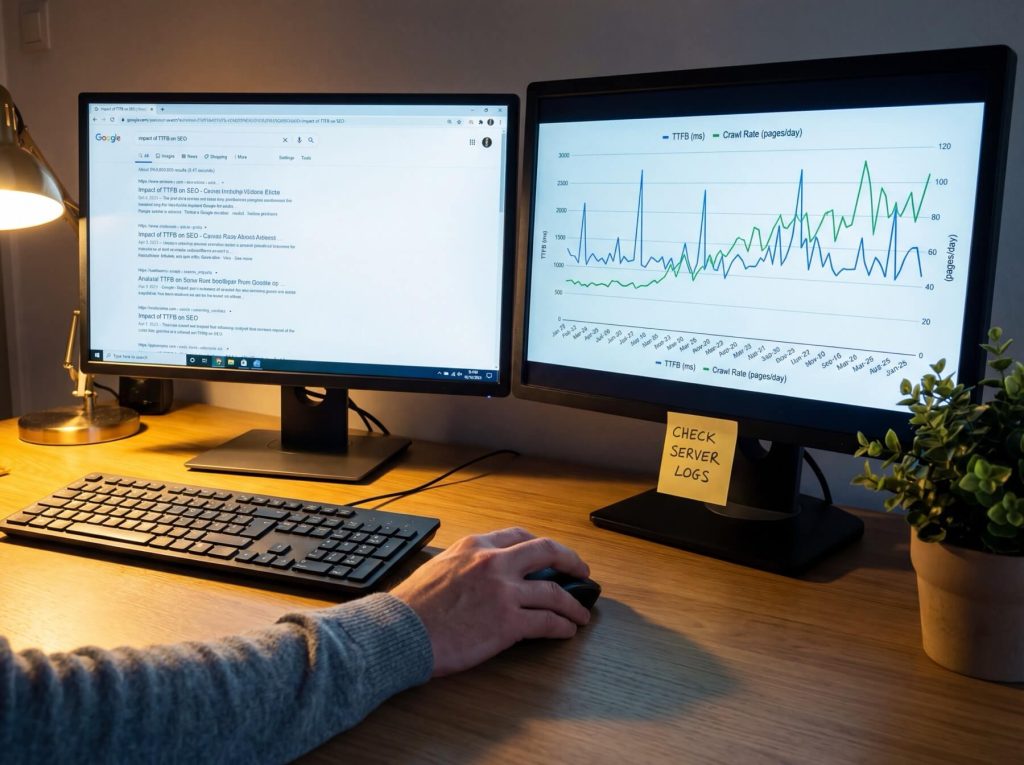
Although TTFB isn’t a direct ranking factor, server responsiveness influences many systems that determine how visible your site is. Google’s page experience documentation focuses on user-centric signals like Core Web Vitals. If the first byte takes too long, both FCP and LCP suffer, compromising overall page performance.
For SEO teams, the key takeaway is that lowering TTFB may not instantly boost rankings but does enhance crawling efficiency, reduce mobile abandonment, and promote more frequent recrawls. Bing follows a similar approach; while TTFB isn’t a direct ranking signal, better speed supports improved crawl efficiency and user experience.
Breaking Down TTFB: A Component-Level View
Understanding TTFB means examining its individual components. It is not a single metric but a chain of delays, including:
- DNS Resolution
- TCP/TLS Handshake
- Server Processing
- First Byte Transfer
Each segment has its own typical duration and common challenges. For example:
| TTFB Segment | Definition | Typical Duration % |
|---|---|---|
| DNS resolution | Time to translate a domain into an IP address through recursive and authoritative DNS lookups | 5–15% |
| TCP/TLS handshake | Time required to establish the TCP connection and complete the TLS encryption setup | 20–35% |
| Server processing time | Time the origin spends executing code, querying databases, and preparing the response | 30–50% |
| First byte transfer | Time for the initial byte to travel from server to client after processing commences | 10–25% |
Network delays in DNS lookups and handshakes can be improved with low-latency, anycast DNS. In contrast, server processing delays typically present the best opportunity for gains.
Measurements using Real User Monitoring (RUM) and synthetic tests (e.g., Chrome DevTools or WebPageTest) provide insight into where delays occur. Careful analysis allows you to prioritize fixes that improve both user and crawler experiences.
Network and Server Factors That Drive TTFB

Once you identify the lagging segment in the TTFB chain, the next step is determining whether the delay is on the network or within your application stack. For instance, a 200 ms delay from DNS and handshake issues requires a different fix compared to a 300 ms delay caused by inefficient application processing.
DNS delays can become significant if recursive paths are long or authoritative servers are slow. Similarly, the TLS handshake might add overhead, especially on intercontinental connections. Inefficient application processing — perhaps due to uncached database calls or slow CMS plugins — is often the primary culprit of high TTFB.
To diagnose these issues, a simple request trace using curl can be invaluable:
curl -w "dns: %{time_namelookup}\nconnect: %{time_connect}\ntls: %{time_appconnect}\nttfb: %{time_starttransfer}\ntotal: %{time_total}\n" -o /dev/null -s https://example.com
If the TTFB significantly exceeds the TLS stage, the problem likely lies with the application or server resource contention. For instance, HostStage’s Unmanaged Linux VPS (starting at $4.95/mo and available in regions such as the USA and Europe) offers a 3 GHz CPU and SSD NVMe storage designed to minimize these delays.
Infrastructure Strategies to Slash TTFB for Global Audiences
When users in distant regions experience slow response times despite favorable local tests, the issue can be geographic. A common solution is to deliver the first byte closer to the user—either via edge caching or deploying regional origins.
For cacheable content, a CDN can reduce TTFB by serving cached pages from nearby edge nodes and reducing the load on the origin server. For dynamic pages, multi-region origins can cut down on overall network travel time. This approach not only benefits users by reducing latency but also helps ensure that crawlers access the freshest content.
Edge caching is particularly effective for static content such as marketing pages, blog posts, and documentation. It minimizes the load on the origin and provides consistent performance. Alternatively, multi-region hosting directs users to the nearest healthy server for dynamic content, mitigating latency even in complex environments.
Prioritizing TTFB Optimizations: A Decision Framework
When addressing TTFB, it is important to prioritize fixes with the highest impact on performance that are relatively straightforward to implement. Quick wins like DNS improvements, TLS tuning, and caching optimizations can reduce latency significantly without requiring extensive engineering time.
Consider the following simplified decision framework:
- Low-latency DNS
- TLS 1.3 & session resumption
- Keep-alive / HTTP/2
- Application caching redesign
- Code profiling & database query optimization
- Eliminating blocking third-party/API calls
- Minor server tweaks
Opportunistic improvements when time permits
- Over-optimizing pages already under 150ms
Diminishing returns territory
The key is to focus on high-impact, low-effort optimizations first. This strategy improves both crawl efficiency and user experience without long development cycles.
Case Study: Real-World TTFB Improvement and AEO Gains

Consider a large content site with global traffic that experienced uneven recrawls, weaker mobile Core Web Vital scores, and limited SERP feature visibility due to high TTFB. The team measured TTFB using both synthetic tests and real user data, noting median values around 480 ms for uncached pages.
After implementing improvements such as full-page caching, TLS session resumption, and edge caching, the TTFB dropped dramatically with measurable benefits:
| Metric | Before | After | Business Impact |
|---|---|---|---|
| Median TTFB | 480 ms | 170 ms | Faster response leading to improved crawl efficiency |
| p95 TTFB | 910 ms | 320 ms | Fewer extreme delays during peak loads |
| Average crawl depth | 3.8 | 5.1 | Deeper crawling promoting fresher content discovery |
| URLs crawled per day | 18,400 | 24,900 | Increased recrawl rates |
| Mobile LCP “good” rate | 54% | 76% | Enhanced mobile user experience |
| SERP feature appearances | Baseline | +22% | Improved visibility in featured snippets |
Lowering TTFB did not change the inherent quality of the content, but it enabled search engines to index pages faster and more reliably. This case study underscores the importance of addressing infrastructure delays to maximize the effects of your SEO and AEO efforts. TTFB may not directly boost rankings, but it does set a ceiling on the benefits that can be achieved through content improvements, crawler efficiency, and user engagement. A combination of edge caching, multi-region hosting, and protocol enhancements like HTTP/3 and TLS 1.3 can be especially effective for global sites.
FAQ
Q1: What is TTFB and why is it important for SEO?
A1: TTFB (Time to First Byte) measures the delay before the first byte of data is received from the server. It affects both crawl efficiency and user experience, which in turn influence SEO performance.
Q2: How does TTFB affect the crawl budget?
A2: A high TTFB means each crawler connection is occupied longer, reducing the number of pages that can be fetched and delaying the discovery of deeper pages.
Q3: What are common optimizations for reducing TTFB?
A3: Common optimizations include improving DNS resolution with low-latency anycast, tuning TLS handshakes, optimizing server processing through caching, and enhancing backend response times.
Q4: How can a CDN improve TTFB?
A4: A CDN reduces TTFB by caching and serving content from edge locations that are geographically closer to the user, decreasing the distance data must travel.
Q5: How do I measure TTFB effectively?
A5: TTFB can be measured using tools like Chrome DevTools, WebPageTest, or real user monitoring (RUM) data. Additionally, a simple curl command can diagnose delays in various stages of the request.