IPv4 was introduced in the 1980s and was the foundation of the internet’s addressing system. But with the growth of the internet blown out of proportion, the inadequacies of IPv4 like address scarcity started to show. This is why IPv6 was introduced. As opposed to IPv4’s 32-bit addressing system with only 4.3 billion addresses, IPv6 utilizes 128-bits. This gives IPv6 an unimaginable number of unique addresses, so it’s safe to say we won’t be facing a scarcity issue anytime soon.
However, that’s not all it has to offer. IPv6 comes with auto-configuration mechanisms like Stateless Address Auto-configuration allows devices to automatically generate their own IP addresses, simplifying network management, as opposed to IPv4 which depends on manual IP address configuration.
iPv6 also comes with security features at a protocol level like the integration of IPsec which enable secure communication across the internet. While it doesn’t eliminate the need for a firewall, IPsec secures connections by encrypting and authenticating data packets at the IP layer.
Deploy IPv4 and IPv6 from Day One
Run a future-ready dual-stack environment with native IPv6 connectivity,
public IPv4, full root access, in 19 Locations.
Dual-Stack Ready
Where IPv6 Actually Stands in 2026
If you are planning an IPv6 rollout expecting to turn IPv4 off afterward, recalibrate. Global IPv6 adoption sits at roughly 40%, and credible projections don’t see full transition completing until around 2045. 2026 is not a switchover year, it is a coexistence year. The practical goal is not “move to IPv6”; it is “serve both protocols cleanly without doubling your operational risk.”
That reframing matters because it changes what success looks like. You are not decommissioning IPv4. You are adding IPv6 alongside it and keeping both healthy for years. Every decision below follows from that reality.
Transition Challenges from IPv4 to IPv6
Although making the change from IPv4 to IPv6 is the obvious best move moving forward, this can be somewhat tricky. One of the most significant challenges would be the scale of changes in network infrastructure. This is because IPv4 has been a networking standard for decades, and to change this legacy equipment with ones that are compatible with IPv6 can be a huge task, costing you manpower, money, and most of all – time.
Another challenge is once you transition from one to the other, it’ll be difficult to communicate between the two protocols. While there are some tools and mechanisms like dual stacking that facilitate having both IPv4 and IPv6, it comes at the cost of some compatibility issues and higher operational costs.
Converting from IPv4 to IPv6 also introduces the hurdle of complexity, as IPv6 is significantly more complex and requires tools and strategies to properly manage the network. Therefore companies would have to invest in tools, strategies, and expert personnel to get the best out of IPv6.
Economic Considerations in IPv6 Adoption
As we discussed, the transition from IPv4 to IPv6 can be financially demanding as it requires a significant initial investment for employee training, software upgrades, and infrastructure. Although this can be a deal breaker for smaller organizations with limited resources, those who can afford to invest in it can enjoy long-term cost savings through improved network efficiency and simplified management.
One of the main reasons why organizations adopt IPv6 is because of the imminent exhaustion of IPv4 addresses, and their increasing costs. To mitigate this risk, the best decision is to go for IPv6, but it’s important to consider the high costs of IPv6 we previously discussed.
This complicated circumstance can be simplified through government intervention. If the govt were to offer financial incentives or tax breaks for companies to deploy IPv6, they could help reduce the burden of initial costs of the businesses and encourage them to adopt IPv6.
Technological Advancements with IPv6
IPv6 overcomes the barrier of limited unique addresses with its 128-bit structure. But this isn’t all that it brings to the table, IPv6 also comes with more technological advancements that address the limitations of IPv4.
Since IPv6 comes with a larger address space and simpler header format, it enables a smoother flow of routing and packet handling. This significantly reduces latency and speeds things up.
In addition to this, IPv6 comes with end-to-end connectivity, making mechanisms like Network Address Translation obsolete. This allows devices to directly communicate with each other, making communication more efficient by simplifying network configurations, and secure by eliminating any potential points of failure.
IPv6 also has commendable scalability and direct addressing capabilities. This makes it suitable for technologies like IoT and cloud computing. IPv6, With its seemingly unlimited address space, can accommodate billions of devices that can be potentially connected to IoT deployments. Its direct addressing capabilities come in clutch for cloud computing as it enables dynamic comms between devices, applications, and cloud platforms.
IPv6 Security Implications and Solutions
Although IPv6 is the new and improved addressing system, it does come with a fair share of quirks, including security risks.
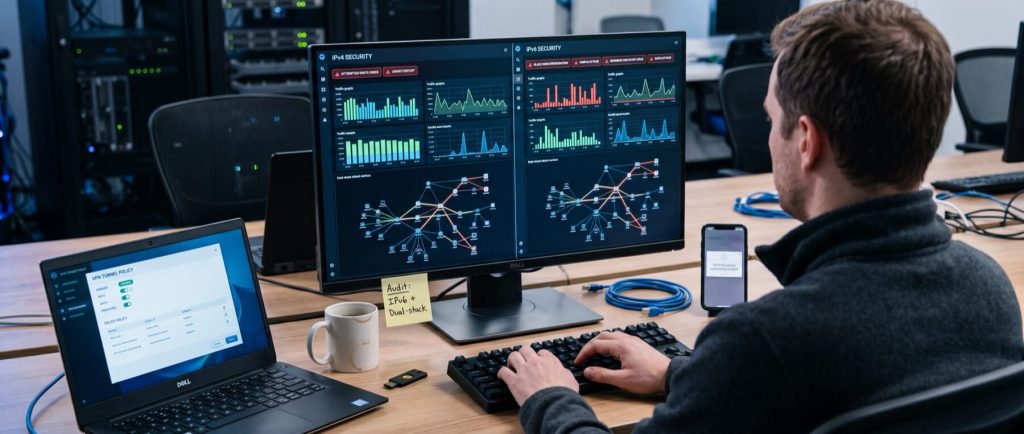
Since IPv6 offers a wider address range, it might increase the attack surface. Threats could enter through devices that have poorly configured IPv6. Dual-stack would double this attack surface, so this should be thoroughly considered. Attackers could also take advantage of IPv6’s auto-configuration capabilities to execute address spoofing or man-in-the-middle attacks.
To overcome such attacks and security threats, it is important that organization update their security policies and make sure they can handle IPv6 threats. This includes properly optimizing IPSec by configuring it to handle threats better.
Since IPv6 is globally routable and permanent, information like device location and network affiliation can be revealed. You can counter these privacy concerns of IPv6 through DHCPv6 which randomizes the IP address of devices.
Needless to say, it’s always a good idea to conduct regular security assessments. This helps you stay aware of any security vulnerabilities that might arise over time, and capitalize on them
Global IPv6 Deployment Status and Trends
As IPv4 addresses run out, and the demand for a higher level of service through IPv6 increases, there is a global shift in unique addressing adoption. This is resuming at an uneven pace across different countries and continents due to their different technological consumption habits.
The highest adoption rates of IPv6 come from France and India. According to Google, France has an adoption rate of 85%, and India with a 75% adoption rate for IPv6. These adoption rates are due to the incentives given by the government and of course the rise in technological advancements. This includes the rise of IoT devices and of course the need for more IP addresses.
| # | Country | Adoption Rate |
|---|---|---|
| 1 | France | 85.07% |
| 2 | India | 75.51% |
| 3 | Germany | 73.51% |
| 4 | Belgium | 68.59% |
| 5 | Malaysia | 66.79% |
| 6 | Saudi Arabia | 65.69% |
| 7 | Guatemala | 59.57% |
| 8 | Greece | 59.32% |
| 9 | Vietnam | 56.54% |
| 10 | Uruguay | 55.65% |
| 11 | United States | 55.54% |
| 12 | Israel | 55.53% |
| 13 | Japan | 54.26% |
| 14 | Hungary | 53.08% |
| 15 | Taiwan | 52.79% |
| 16 | Brazil | 52.05% |
| 17 | Sri Lanka | 51.29% |
| 18 | Puerto Rico | 51.06% |
| 19 | Estonia | 50.74% |
| 20 | United Kingdom | 50.56% |
When we look at it in terms of industries, the highest investors in IPv6 are telecommunication companies, Cloud Service Providers, and Internet Service Providers because they have to accommodate the constantly growing number of devices. Content Delivery Networks like Cloudflare, Akamai, and Google Cloud CDN take advantage of the routing capabilities and polished network systems to deliver content across the globe.
The Future of Internet Networking with IPv6
As new generations of technology are ushered into the gaze of the public, the need for unique addressing only increases. As IPv6 can accommodate approximately 340 trillion devices, it’s safe to assume we wouldn’t face an address scarcity like with IPv4.
However, the strengths of IPv6 go beyond just sheer quantity and availability. IPv6 offers significant security improvements over IPv4, as it is more than capable of holding its own against cyber attacks and maintaining integrity in data transmissions. IPv6 also, as we discussed, has very smooth data routing that allows it to maintain fast and efficient transfers. This particularly comes in handy in technologies that require quick data transmissions like remote surgery and autonomous vehicles and satellites
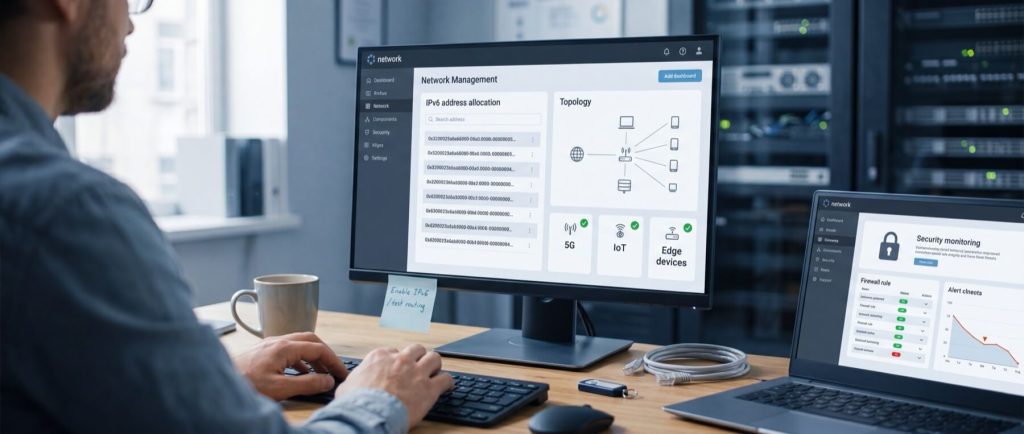
IPv6 has proven to be a worthy vessel for new technologies, this includes 5G. As time goes on, the number of mobile devices will only increase, as this indefinite demand needs a potentially unlimited supply of addresses, IPv6 proves to be a good fit. For the same reason, IPv6 is also a perfect match for IoT devices, enabling thousands of devices and sensors to be connected to the same network if the need be. This allows the companies to adopt IPv6 to a range of applications, from smart homes to smart cities.
The functionality doesn’t end here. IPv6 is always undergoing constant research and development to iron out the quirks in this relatively young Internet Protocol addressing system. This could mean that this already future-proof design can be polished to be an all-rounded system that fosters the technological evolution that is yet to come.
Frequently Asked Questions
What percentage of the internet uses IPv6 in 2026?
Is dual-stack or IPv6-only better?
Why is migrating from IPv4 to IPv6 so hard?
Does IPv6 improve performance?
Do HostStage servers support IPv6?