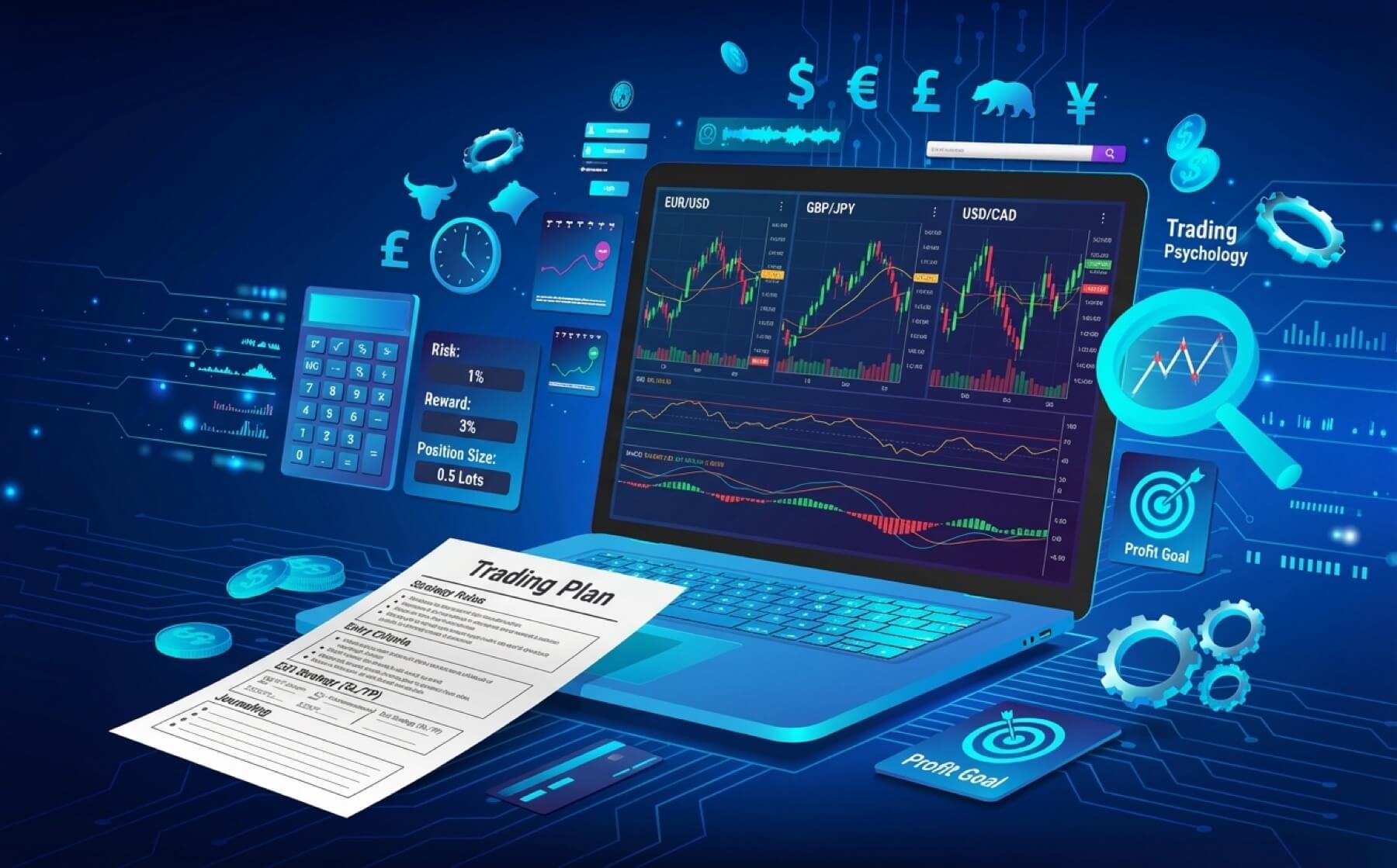
Build a Forex Trading Plan
If you trade forex with no plan, you are likely to fail. Studies show that 90% of retail traders lose cash. Yet, those with a clear trading plan do 25-40% better. A plan cuts out feelings when choosing trades, sets firm rules for when to get in and out, and helps you keep risk in check.
This guide is for forex traders – new or seasoned – who aim to build a solid plan for better steadiness and results. Here’s what you’ll learn:
- Find your trading edge (your strategy that works over and over).
- Make rules for when to start and stop a trade to avoid random choices.
- Control risk by keeping trades small and setting limits on losses.
- Keep track of and check your progress to polish your plan.
The Issue: Most Traders Lose Money Without a Plan

Forex trading is hard. Studies from big brokers show that a lot of retail traders don’t make money in the long run. Here’s the twist: it’s often not because they lack smarts or know-how about the market. The real problem? Many treat trading like betting, not like a serious, well-run business.
Without a solid, written plan, traders often fall into usual traps. They might follow “hot tips” from social media, switch strategies after a few losses, or risk different amounts that mess up even good plans.
Emotions are another big block. Fear can make traders close winning deals too soon, while greed makes them keep losing ones too long. Without clear, set rules, market shifts can make emotions take over, ruining even the best plans.
Another issue is not having clear goals for success. Without these, traders might be happy with short-term wins but then lose it all in the next market turn. A planned approach not only stops quick, thoughtless choices but also builds a disciplined, trackable way to trade.
How Structure Makes You Disciplined in Trading
A structured trading plan is like a map – it cuts out the guessing from deciding what to do next.
With a plan, being disciplined gets easier. You set the rules early, so instead of just looking at charts and doubting, you know when to act. This way also helps manage risks. Before you trade, you’ll know how much you can risk, and your trade size fits what you have in your account.
A tested plan not only guides you – it gives you confidence. Even when you’re losing, sticking to your rules can lower stress and help you keep going. Being clear and steady is key, and that’s when good technical follow-through is essential.
Why VPS Hosting Makes Sure Trades Go Smoothly
Doing trades well is as crucial as having a strong plan. Small issues, like losing internet or power, can cause missed chances or late outs – which hurt your trading.
A Virtual Private Server (VPS) fixes these problems by running your trading program on top-notch setups, 24/5. With a VPS, platforms like MetaTrader 4/5 stay linked to your broker, making sure your exit rules work right – even if your own system is down.
This sureness is vital for automated plans and Expert Advisors (EAs). If you’ve tested a plan and set detailed rules, you need those rules followed exactly in real trading. A VPS makes sure your automatic systems work non-stop, keeping the conditions the same as when you tested your strategy.
Also, VPS servers, usually set up close to main financial spots, offer less delay – this means quicker trade moves than regular home web. When every tiny bit of time counts, those few milliseconds can mean the line between getting your desired price or losing that trade all together.
Find What Makes You Stand Out in Trading

Serious business man trader analyst looking at computer monitor, investor broker analyzing indexes, financial chart trading online investment data on cryptocurrency stock market graph on pc screen.
Before you start to make a plan for your trades, you must find out what makes you do well in the market. This is your trading edge – what makes some traders win while others lose money.
What’s a Trading Edge?
A trading edge is a strategy or pattern you can use over and over, and it helps you win more often than not. It’s not about always being right. It’s about winning enough times, with good enough wins over losses, to make money after many trades.
Think of it like how a casino has an edge. Casinos don’t win every bet, but they do well over many bets because they have a math edge. Your trading edge is the same – it’s all about the numbers.
A true edge is measurable, repeatable, and profitable over many trades. Without these, you’re just gambling with nice-looking charts.
Some traders think they have an edge after a few good weeks. But a real edge is proven over many months or years. It works by using patterns that happen often in the market, like currency moves in busy times or how certain news changes prices.
How to Explain Your Edge
To show your edge, you need to be clear about what you trade and why it works. Simple ideas like “buy when it feels right” are not enough.
You could set up your edge like this:
- My Edge: [specific pattern or setup] is good because [clear reason based on market patterns].
- Tested on: [currency pairs and times].
- Average Risk-Reward: [ratio like 1:2 or 1:3].
Look at these examples:
- A breakout trader might say: “Breakouts in the London session on EUR/USD are good because more trading by European traders pushes prices for 2-4 hours. Tried on EUR/USD 15-minute charts from 3:00-6:00 AM EST. Risk-reward: 1:2.5.”
- A trend follower could say: “Moves based on moving averages on daily charts are good because they go with long trends that last weeks. Tried on main pairs (EUR/USD, GBP/USD, USD/JPY) on daily charts. Risk-reward: 1:3.”
Be specific. Don’t just talk about “support and resistance.” Say something like: “Prices jump from past daily highs/lows, seen at least three times.” Use clear terms over vague ones, like “RSI over 70 with price dropping on 4-hour charts” instead of just saying “overbought.”
Your edge should also fit how you live and who you are. For example, if you have a full-time job, don’t plan on trades that need watching every minute. If you don’t like risks overnight, don’t go for swing trading.
Check Your Edge with Backtesting
Once you have your edge set up, check it with past data. This backtesting shows if your great idea really holds up.
Good backtesting calls for you to look at many months or even years of price charts and note every trade your rules would have set off. You must get at least 100 trades – better if you have more – to get trusty results.
When backtesting, keep a tab on these points:
- How many trades
- Win rate
- On average, how much you earn per win
- On average, how much you lose per loss
- Biggest drop
- Total gain or loss
If your method does not make money well and often, you need to work on it more.
Backtesting by hand can be a drag, which is why many strong traders lean on tools like MetaTrader’s Strategy Tester or other backtesting setups. Yet, it’s key to make sure your backtesting setting looks a lot like real trading conditions.
For instance, if your setup often crashes or you have net issues, your results may not hold true. Many traders go for VPS (virtual private server) to keep backtesting smooth and data steady. A VPS is really handy when trying out many methods or doing big backtests that take hours to finish.
Step 2: Make Clear Entry and Exit Plans
After you know your trade edge, you need to make clear rules for when to start or stop a trade. These rules are key to a strict trade plan. Without them, choices may shift and be too tied to feelings. Top traders use set rules to cut out guesses and keep things same.
Your rules should be so clear that anyone could use them and trade just like you would.
Entry Rules: What Tells You to Trade
Entry rules must be direct and clear. Unclear tips like “buy when price goes above line” are not good. Instead, use clear rules like: “Buy when the 15-minute candle ends higher than the last day’s top with 20% more volume than the last 10 times.”
Here’s what typically goes into entry rules:
- Main Signal: Find the key pattern or event you’re looking for (e.g., EUR/USD going higher than the 8 AM EST top).
- Extra Checks: Add more checks to be sure, such as “RSI under 70”, “price up from the 50-time moving average”, or “at least 2 hours left in the London hours.”
- Market Setting: Think about the wider market state, like days with less news, normal shakeups, or key lines at least 30 pips away.
For instance, a London breakout trader might use these clear rules:
- EUR/USD must go up or down more than the 2 AM – 8 AM EST range by 5 pips.
- The move must happen between 8:00 AM and 11:00 AM EST.
- No big news should come up in the next 2 hours.
- ATR (Average True Range) should be 80–120 pips.
- The risk-to-reward should be at least 1:2.
- Size your position to risk no more than 2% of your money.
See how these rules cut out any guesswork or feelings. If all boxes are ticked, the trade is on. That strictness keeps things same and drops emotional choices.
Write your entry rules so well that a stranger could do them just right. If you often twist your rules, they are not clear enough.
After your entry rules are set, think about how and when to end your trades.
Exit Rules: When to Take Profit or Cut Loss
Exit plans are as needed as entry rules, but often don’t get as much focus. How you leave a trade greatly shapes your final results. Staying true to your exit plan is core.
You need three types of exit rules for all trade cases: stop-loss, take-profit, and time-based exits.
Stop-Loss Rules: These keep your account safe from big drops. Set your stop-loss points based on clear tech signs, not just random numbers. For example, you might set a stop-loss “5 units below the breakout point” or “get out if the price is under the 20-period line on the 15-minute chart.” When your stop-loss is set, leave it there.
Take-Profit Rules: Be clear on when to take your gains. Some traders like set risk-to-reward ratios like 2:1 or 3:1. Others use tech marks, like “leave at the next big block” or “sell half when the price is 2x the risk, and let the rest go to 4x the risk.” Using steps in how you leave can help you save gains while still trying to get more.
Time-Based Exits: Not all trades work out, even if they don’t hit your stop-loss. Make rules based on time, like “leave if no move towards the goal after 4 hours” or “shut all before big news in 30 mins.”
To keep on track, think about using set alerts or tools to help you leave without your feelings getting in the way. For those who handle many pairs or use Expert Advisors (EAs), a VPS can make sure you have smooth actions. Options like auto trail stops that change every 15 minutes or small cash outs at key points are best with regular service.
Your rules for getting out should stay the same, in good or bad market times. Letting feelings decide when to leave can mess up even the best start plans. Stick to your plan and let your rules lead what you do.
Step 3: Deal With Risk and Set Loss Stops

Dealing with risk is key to good traders not quickly losing all their money. Even a top trade plan won’t help if you risk too much at once or skip setting loss stops. Good traders care about keeping their money safe first – making money comes after.
To show this, losing 10% needs an 11.1% gain just to get back to even, and a 50% loss needs a big 100% gain to recover. So, it’s key to set how big your trades are and how much you can lose for long-term wins.
Set Your Trade Size
Trade sizing is a way to manage how much you risk each trade, based on how much money you have and what you’re okay with losing. The math is easy: Risk per trade (%) × Money you have = Most you can lose per trade in dollars.
Most pros risk between 1% and 2% per trade. Here’s a fast look at what different risk amounts mean for a $10,000 account:
| Risk Each Trade | Top Loss Each Trade | Trades for Half Loss | Gain to Get Back |
|---|---|---|---|
| 1% | $100 | 69 straight losses | 100% rise |
| 2% | $200 | 34 straight losses | 100% rise |
| 5% | $500 | 13 straight losses | 100% rise |
For instance, if you trade with $5,000 and risk 2% ($100) on a trade with a 30-pip stop, each pip is worth $1 per mini lot. This means you would trade about 3 mini lots.
The main thing here is being strict – your trade size must always match your set risk rules. This way, you take out feelings from the mix, which helps you not trade too much when you win a lot or rush in after a bad trade.
If you use trading tools that work on their own, a VPS (Virtual Private Server) can make sure your trade size rules are always followed. A VPS keeps running all the time, making sure that trades and math are not stopped.
Once you know your trade size, the next move is to set hard loss limits to keep your account safe.
Set Max Loss Limits
To protect your money, you need clear rules on how much you can lose each day and in total. These limits are like safety stops, keeping a small loss from turning into a huge one.
Daily loss limits control what you can lose in one day of trading. Many trading firms use a 5% daily limit. If you lose 5% of your funds in one day, you stop and wait until the next day to trade again. This stops you from making quick, feeling-driven trade decisions to try to win back what you lost.
Total loss limits have a wider view, setting a cap on the most your account can drop from its top value. Often, this cap is 10%. For example, if your account’s highest amount was $12,000, a 10% cap would mean you stop trading if your money goes down to $10,800. Then, you’d look over your trades, find errors, and fix your strategy before trading again.
Auto tools can keep these limits in check. For example, with trading systems like MT4 or MT5, you can set alarms to tell you when you’re nearing your loss limit. A VPS ensures these alarms and checks keep going, even if you’re not there.
It’s key to set these rules when you’re calm and follow them when the market is wild. Your trading plan should be clear on what counts as a “loss day” and what you’ll do to get back on track. For example, you might wait for some good trading days before going back to usual trade sizes, or lower your risk per trade till your funds are back up. Stay away from unclear rules like “take a break if it gets bad” – they won’t help when you’re down $500 and hoping the next trade will turn things around.
Step 4: Keep an Eye on Results with Frequent Checks
Frequent checks on how you’re doing can really make the difference between traders who grow and those who just keep making the same errors. Those who make money often have a weekly routine of going over their trades, which gives them a real advantage over others who trade but don’t look closely at their outcomes.
Kyle Janas puts it simply:
“If you’re not systematically reviewing your trades weekly, you’re essentially trading blindfolded, hoping to stumble into profitability.”
Run checks often in your trade game to stay on track and fix things when needed.
Main Things to Watch
It’s key to know the right things to watch in your trade game. Every forex trader needs to keep an eye on these:
- Win Rate: This checks how many of your trades make money out of all your trades. A win rate over 60% is good and shows you do well often, but look at it with your risk-reward rate for a full view.
- Risk-Reward Ratio: This tells you how much you make on wins versus what you lose on losses. A rate of 1:2 or more is best, meaning you try to make at least $2 for each $1 you may lose. Even if you win less often, this rate can keep you winning.
- Maximum Drop: This finds the biggest drop in your account from its highest point. Keep this below 10% to get back from bad times without too much harm to your account.
- Trade Times: This counts your trades each week or month. Watching this helps you stick to your plan and stop too much trading when the market is wild.
- Profit Factor: This figure is your total wins split by your total losses. A profit factor over 1.25 means your trading plan works well.
Use this easy chart to keep track of these things:
| Measure | Meaning | Goal | Now Result |
|---|---|---|---|
| Win Rate | % of trades that make money | > 60% | |
| Avg Risk-Reward | Avg RR for each trade | ≥ 2:1 | |
| Max Drawdown | Big drop in account | < 10% | |
| Trade Frequency | Trades each week | Follow plan | |
| Profit Factor | Gains ÷ Losses | > 1.25 |
These numbers help improve your trade plans as time goes.
Check Your Trade Results
After you log your numbers, look at them and spot the key takeaways. A careful look often shows that most of the gains come from a few setups. Andre, a pro trader, points this out:
“The daily trade reviews are very important for my development as a trader. By consistently analyzing my previous trades, I’m getting more important insights to refine my trading system.”
Each weekend, take 60 to 90 minutes to look over your trades well. This step is just as key as making the trades. Kyle Janas points out how big this is:
“The weekly review isn’t just some administrative task – it’s the hidden engine driving every consistently profitable trader I know.”
Look at your trades in sets of 20 to 50. This can show you real patterns apart from mere random changes. Don’t be down by a few losses; keep your eyes on your total game.
Use tools like Google Sheets or Notion to track your numbers. If you’re on MT4 or MT5 on a VPS, you can pull out your trade past for good records. A VPS-hosted site makes sure your data is right for checking.
More than just numbers, write down how you felt with each trade, why you got in, and what the market was like. This lets you see not just what went on, but why. For instance, do you often lose when big news hits? Or maybe you find you do bad on Friday PMs when there’s not much money moving? This kind of info is key to get better at trading.
A VPS site can also set up reports and alerts by itself, which cuts down on mistakes and keeps things neat. By keeping a steady watch and looking things over well, you can fine-tune when you enter or leave and how you handle risk, leading to better trade results as time goes on.
Step 5: Get Your Free Trading Plan Template
This simple to use template helps you set your trade edge, rules, and risk levels into one easy, doable plan. Writing out your trade plan gives you a daily guide to stick to. Think of it as your own guide of rules – making you stay the same and, in the end, make money.
How to Fill Out the Template
Your trade plan should have nine key parts. Each one helps build your whole trade way.
Kick off by writing down your trade edge and the proof that backs it. Say: “I aim at London session breakouts for EUR/USD because the high trade amount at this time shows clear path moves with a 2:1 risk-reward.”
Then, lay down your entry rules with clear terms. Like: “Start a long spot when the price goes over the last day’s high, RSI is over 50, and trade goes up by 20%.” The clearer your rules, the easier to follow when things get hot.
Also, write out your exit rules. Add profit aims, stop-loss levels, and when to close. Like: “Cash in at twice the risk, place a stop-loss at the closest help level, and end all spots by 4 PM EST.”
In terms of risk per trade, use a part of your cash pile, not a set cash sum. Most old hands risk between 1% and 2% of their pile on any one trade.
Set a top drawdown cap as a safe fence. You might stop for the day or week if you drop 5% to 10% of your pile value.
Pick your tools and timeframes to fit your life and trade way. Say, with a full-time job, you might look at daily maps and big cash pairs. Day traders may like 15-minute maps for EUR/USD or GBP/USD during London and New York times.
Plan a check schedule that fits your trade style. Day traders might check each week, while swing traders might look each month. Use these checks to tweak and better your plan over time.
Copy the Free Template
Here’s a custom trade plan template for you to fill:
A lot of traders like to keep their plans on things like Google Sheets or Notion so they can get to them easy. If you trade on apps like MT4 or MT5 on a VPS, you can set up alerts that help you follow your plan. A VPS makes sure your trading app stays on all the time, even when you’re not by your computer. This lets the auto systems work on your plan as needed.
End: Stick to Your Plan for Steady Wins
A trading plan is your map to keep making money. Without a set guide, trading may soon turn into a risky bet more than a smart, planned move.
As said before, what makes traders win often is how well they stick to set rules. Study shows that about 60% of traders who make money spend time to plan or write down their trading steps. By making clear when to get in, get out, and setting risk limits, a plan cuts down unsure moments and stops you from making quick choices based on feelings.
This kind of strict rule-following also helps when using tools like a VPS for smooth moves. Having your MT4 or MT5 on a VPS keeps it running well, even if there are tech problems, so your plan works as it should.
Writing down every move is key too. Studies show having a detailed trade log can up your chance to remember why you made a choice by more than 20%. This tells us that using facts to tweak your moves beats trusting your gut when trading.
Start now with the free trading plan layout below. Follow it for at least 30 trades, noting each start, end, and outcome. By merging this plan with your proven tactics, you’re giving yourself a better shot at regular wins in the market.