
Best VPS Location for Your Forex Broker
When trading Forex, the location of your VPS (Virtual Private Server) plays a critical role in reducing latency and improving order execution speed. The closer your VPS is to your broker’s server, the faster your trades will process, minimizing slippage and requotes. Forex brokers typically host their servers in four key hubs: London, New York/New Jersey, Tokyo, and Singapore. Choosing the right VPS location depends on your broker’s server location and your trading strategy.
Key Points:
- New York: Best for US-based brokers and trading USD pairs. Latency: 2–6 ms.
- Tokyo: Perfect for trading JPY pairs during the Tokyo session. Latency: 1–3 ms.
- Singapore: Suitable for multi-broker setups and Asia-Pacific trading. Latency: 1–5 ms.
- London: Ideal for European brokers and traders active during the London session. Latency: 1–4 ms.
Quick Tip:
Match your VPS location to your broker’s server for faster execution and better trading performance. For example:
- Use London for EU brokers like LMAX.
- Opt for New York for US brokers like OANDA.
- Choose Tokyo for brokers in Japan.
- Select Singapore for brokers serving Asia-Pacific.
By aligning your VPS with your broker’s infrastructure, you can significantly reduce delays, improving order accuracy and reliability.
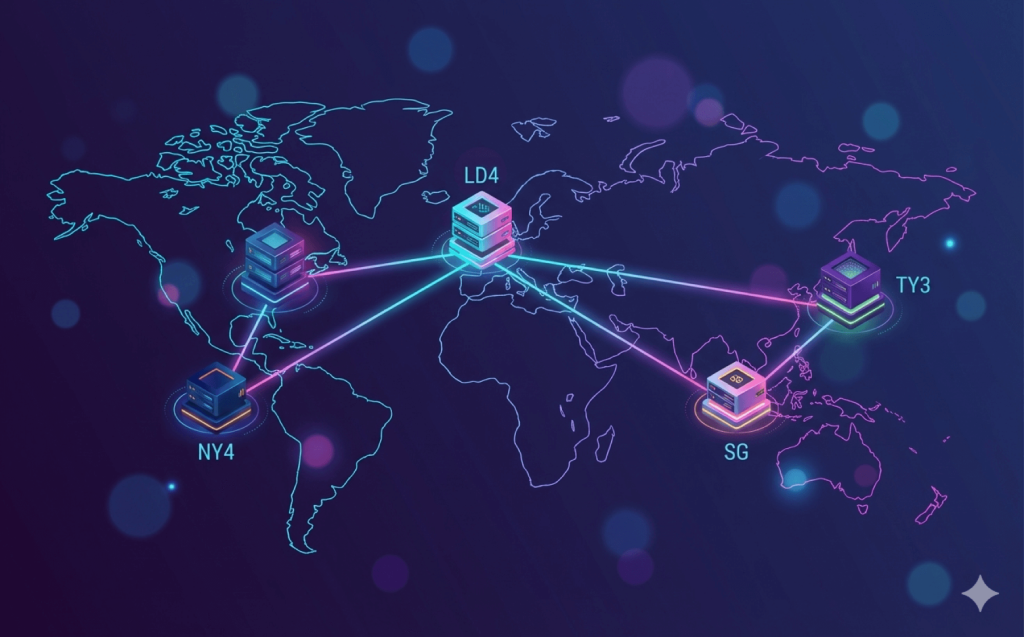
New York/New Jersey
New York/New Jersey region, acts as the central hub for US-regulated Forex trading. It’s specifically designed to support brokers operating under CFTC regulations, providing the infrastructure needed for smooth and reliable trading.
Latency
An East Cost US VPS offers latency between 2–6 milliseconds to US broker servers, keeping trade execution within the optimal range for retail trading and significantly reducing slippage. Since platforms like MT4 and MT5 process orders sequentially, even a small delay – like 10 milliseconds – can disrupt order fills during volatile market conditions. NY4’s network infrastructure remains steady even during periods of heavy trading volume, making it an ideal choice for traders who rely on low-latency connections.
Broker Compatibility
Most US-based brokers operate through NY4. Brokers such as FOREX.com (a part of StoneX Group Inc.), OANDA, FXCM, and IG US all route their orders through this datacenter. To confirm if your broker’s MT4 or MT5 server is hosted in NY4, a simple traceroute to your broker’s IP address can provide clarity.
Trading Use Cases
The robust connections provided by NY4 are a game-changer for various trading strategies. Traders who are active during US trading hours, particularly those capitalizing on the London–New York session overlap, see significant benefits from an NY4 VPS. Scalpers focusing on USD pairs during high-liquidity periods benefit from the reduced latency, which helps prevent order delays. Automated trading systems, especially those running during major US economic events like Non-Farm Payrolls, FOMC announcements, or CPI data releases, execute trades more reliably when close to US broker servers. Additionally, copy traders who follow US-based signal providers enjoy better synchronization when both the signal provider and follower accounts are hosted near the same datacenter.
Execution Quality
FOREX.com highlights its commitment to execution quality with its Next-Gen Pricing Model, which features ultra-tight spreads as low as 0.0 pips for major pairs, paired with a $7 USD commission per $100,000 USD traded under their RAW Spread pricing.
NY4 minimizes issues like jitter and packet loss, ensuring that orders reach broker servers quickly and reliably – even during volatile periods with wider spreads. By aligning your VPS location with your broker’s server – such as NY4 – you can ensure smooth and dependable trade execution.
Tokyo
Datacenters situated in Tokyo, are a top choice for traders focusing on the Asia-Pacific market, especially those trading JPY currency pairs. Its location near Tokyo’s major trading hubs ensures lightning-fast latency – often as low as 1–3 milliseconds – making it ideal for executing trades during the Tokyo session.
Latency
A Tokyo-based VPS offers incredibly low latency to broker servers in the region, which is critical for trading JPY pairs during active market hours. This near-instant communication allows for faster automated responses, aligning perfectly with broker infrastructures in the area.
Broker Compatibility
Many brokers catering to the Asia-Pacific market host their servers in Tokyo. To determine if your broker uses a Tokyo-based server, check for references to Tokyo or Asia in your MT4 or MT5 server names. You can also run a traceroute to confirm if the final network hops lead to Tokyo. These steps help ensure you’re leveraging the strategic advantage of local server compatibility during peak trading hours.
Trading Use Cases
For traders focused on JPY pairs and active during Asia’s busiest market hours, a Tokyo VPS places your trading environment closer to regional liquidity pools, optimizing your performance.
Execution Quality
The combination of low latency and proximity to broker servers minimizes delays and ensures smoother order execution. For traders relying on precise timing and automated strategies, this setup is invaluable during the high-activity Asia-Pacific trading sessions. Faster execution can make all the difference for strategies that demand split-second accuracy.
Singapore
After exploring Tokyo’s cutting-edge connectivity, Singapore stands out as another excellent choice for traders aiming for reliable regional and global access.
Thanks to its prime location and strong network infrastructure, Singapore offers dependable connectivity for trading across the Asia-Pacific region and beyond.
Latency
Using a Singapore VPS typically provides steady latency with minimal fluctuations. However, the actual performance can vary depending on your broker’s server setup and the network routes in use.
Broker Compatibility
To ensure compatibility, check if your broker’s server is listed as “SG” or “Singapore.” Running a traceroute can also help confirm the exact data center routing.
Trading Use Cases
For traders focused on Asian markets or handling portfolios across multiple brokers, Singapore offers well-rounded connectivity during various trading sessions. This balanced network performance plays a key role in improving trade execution.
Execution Quality
A Singapore VPS helps reduce delays and delivers consistent performance, which is crucial for automated trading systems and strategies that rely on precise timing. It’s an excellent choice for traders whose broker servers are optimized for Singapore’s network, complementing other major VPS hubs around the world.
London
London stands out as a prime VPS location, offering a strong financial infrastructure that supports low-latency MT4/MT5 trading.
Latency
Using a VPS in London can dramatically cut down latency. Since MT4/MT5 platforms process orders sequentially, even slight delays can impact execution during volatile market conditions. London’s advanced network setup, featuring reliable connections and redundant fiber paths to major European exchanges, ensures orders are handled more consistently and with fewer interruptions. To maximize this advantage, confirm that your broker’s servers are based in London.
Paris may also be suitable to trade on the London platforms in spite of notorious slight evening latencies in the English Channels backbone (past market hours)
Broker Compatibility
Many brokers under EU regulations route their order flow through data centers in London. If your broker’s MT4/MT5 server details suggest a London-based connection, running a traceroute could reveal IP addresses tied to the region. This can help confirm that syncing your VPS location with your broker’s server might improve your trading connection. Such alignment not only boosts connectivity but also lays the groundwork for more efficient trading strategies.
Trading Use Cases
For traders active during European market hours, an London VPS can be particularly advantageous. Those using scalping strategies or automated trading systems (EAs) will find that reducing latency enhances execution consistency and minimizes slippage, giving their strategies a better chance to succeed.
Execution Quality
London’s low-latency and stable network environment contribute to improved execution quality. This setup reduces issues like requotes and ensures smoother order processing. The consistent, low-jitter connectivity in London is especially beneficial for automated trading, enhancing performance and reliability.
Additional analyses of VPS locations like USA, Netherlands, Frankfurt, Singapore can help refine your choice based on your broker’s server location and trading needs.
Advantages and Disadvantages by Location
Each VPS region offers distinct benefits and challenges. Here’s a breakdown of the key factors to consider for each location.
New York/New Jersey
New-York is the go-to region for North American forex trading. It’s the primary hub for US-regulated brokers such as OANDA, FXCM, and Forex.com, offering latencies of 2–6 ms when paired with the right broker. This location shines during the New York session, especially for USD pairs and commodities. But for those targeting Asian session trades, the geographical distance can lead to increased latency.
Tokyo
Tokyo is a strong choice for traders focusing on JPY pairs and strategies tailored to the Asian session. Brokers like Rakuten Securities and GMO Click often operate through Tokyo’s infrastructure, delivering latencies as low as 1–3 ms for traders in the region. However, its benefits are limited if your broker’s servers are located outside of Tokyo.
Singapore
Singapore acts as a key hub for the Asia-Pacific region, known for its strong global connectivity. It supports brokers with significant infrastructure in the area, offering latencies of 1–5 ms. Singapore is a solid option for traders managing multiple brokers or seeking balanced access across various sessions. That said, if your broker’s servers are in London or New York, you won’t achieve the same ultra-low latency.
London
England serves as a hub for European and global FX liquidity. Its biggest perk? Proximity to a high concentration of ECN/STP brokers like LMAX and CMC Markets, with latencies as low as 1–4 ms. This makes it ideal for fast order execution during the London session and its overlaps. However, if your trading focuses on the Asian sessions, London’s advantage diminishes significantly due to its location.
| Location | Typical Latency | Best For | Primary Limitation |
|---|---|---|---|
| London | 1–4 ms | EU brokers, ECN/STP platforms, London session | Less effective for traders focused on Asian sessions |
| New York | 2–6 ms | US-regulated brokers, USD pairs, New York session | Higher latency for Asian market trades |
| Tokyo | 1–3 ms | JPY pairs, Asian session trading, Tokyo open | Limited advantage if broker servers aren’t in Tokyo |
| Singapore | 1–5 ms | Multi-broker setups, Asia-Pacific focus | Suboptimal for brokers based in Europe or the US |
Matching your VPS location to your broker’s server is crucial for optimal trading performance, as previously emphasized.
Special Considerations for Specific Setups
Multi-Broker Setups
Traders working with brokers across various regions often face execution delays when relying on a single VPS. To address this, deploying separate VPS instances in each region ensures consistent execution speeds across accounts.
EA-Heavy Strategies
For traders using Expert Advisors (EAs), low and stable latency is critical. Even with low ping, network inconsistencies (like jitter) can disrupt EA performance. The solution? Align your VPS location with your broker’s server and prioritize network stability to keep automated strategies running smoothly.
Manual Trading
While manual traders can handle slightly higher latency, volatile market conditions can make high latency a problem, leading to requotes or execution errors. Choosing a VPS location close to your broker’s server minimizes these risks and improves reliability during fast-moving markets.
Conclusion
Choosing the right VPS location is crucial for minimizing latency and enhancing your trading performance. Here’s a quick guide to help you make the best decision:
- US Brokers (e.g., OANDA, FXCM): Opt for NY4 with latency as low as 2–6 ms. This is ideal for traders using scalping strategies, high-frequency trading, or automated Expert Advisors.
- European Brokers (e.g., LMAX, Pepperstone UK, CMC Markets): Go with London for 1–4 ms latency. This region is perfect for those trading the London session or focusing on EUR/GBP pairs, thanks to its dense ECN and STP liquidity.
- Asian Brokers (e.g., Rakuten Securities, GMO): Tokyo is the best choice with 1–3 ms latency. It’s particularly effective for JPY pairs and strategies centered around the Tokyo open.
- Multi-broker setups: Singapore offers balanced connectivity with 1–5 ms latency, making it a solid option for traders managing multiple accounts or seeking global session access.
Using a VPS in the wrong region can cause unnecessary latency, leading to slippage, requotes, or inconsistent trade fills – especially during high-volatility periods. If you’re working with brokers in multiple regions, consider deploying separate VPS instances in each hub to maintain optimal execution speeds across all accounts.
The bottom line? Matching your VPS to your broker’s server ensures faster execution, reduced slippage, and more consistent results. Since VPS location is one of the few factors you can fully control, take the time to measure your latency and make adjustments as your trading needs evolve.